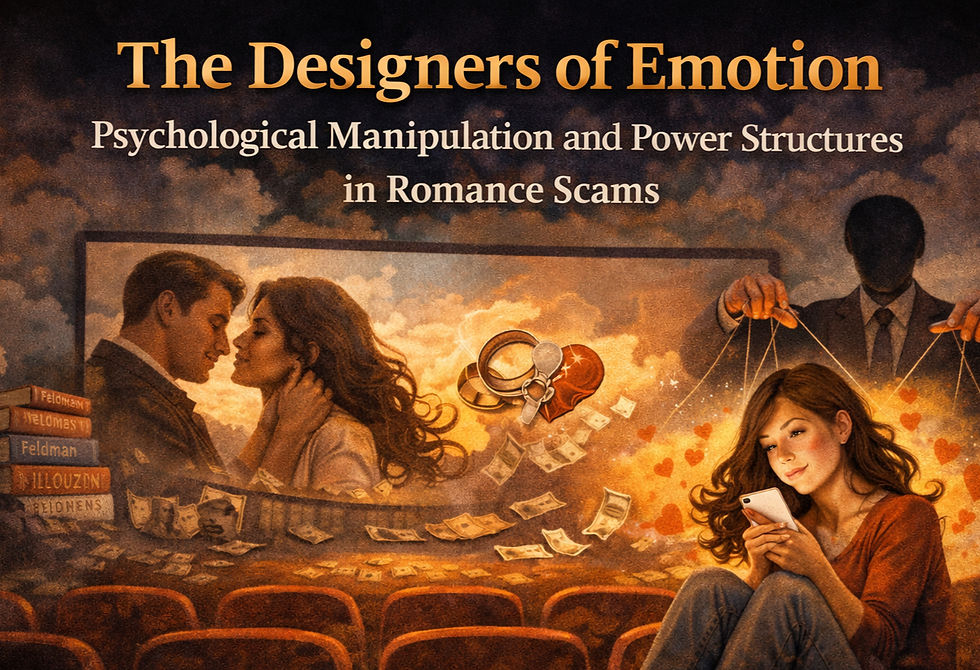
The Designers of Emotion: Psychological Manipulation and Power Structures in Romance Scams – Part 2 | Romance Scam Brainwashing

In Part 1 of "The Designers of Emotion," we established that scammers weaponize the cultural narrative of "romance" to create a manufactured emotional reality. We distinguished between authentic, relational love and the staged, scripted performance of romance that forms the basis of their attack.
But how does this manufactured reality become so powerful that it can override our logic, intuition, and even our own will to resist? How can a fictional narrative, delivered through a screen, feel more compelling than truth?
The answer lies not in a failure of character, but in the architecture of the human brain. In Part 2, we move from the cultural to the neurological, exploring the specific mechanisms—like the "amygdala hijack"—that scammers exploit to bypass rational thought and seize control. Understanding this is the key to reclaiming your agency.
First, we need to talk about how romance regulates our emotions and leads us into irrational judgment. As I said in the previous post, True love is relational; it takes time. Romance is structural; it is an immediate, device-like stimulus, and even the moment we believe we have “fallen in love at first sight” is highly likely to be the result of an already learned romantic narrative activating first. That is because “scenes of love” are repeatedly injected into dramas, films, novels, and music, till they settle into our unconscious.
A substantial portion of what we consider “natural” emotion is not wild or natural; it is constructed by an external script.
Eva Illouz, in Consuming the Romantic Utopia (1997), analyzes that modern feelings of love do not naturally arise from an individual’s inner self, but are constructed by romantic images continuously produced by popular culture, advertising, film, and literature. Illouz says that love is structured by the symbolic resources provided by culture. In other words, even what we believe to be “natural emotions” are in fact the result of internalizing romantic narratives manufactured by the cultural industry [1].
Janice Radway, in Reading the Romance (1984), argues that romantic feeling is a specific emotional structure constructed by novels, media, and popular culture, and that readers learn “what love should be” through the romance genre. Her research shows that romantic feeling is essentially a narrative-based emotion. That is, the very way we feel romance is already defined by a constructed external narrative [2].
Sara Ahmed, in The Cultural Politics of Emotion (2004), defines emotion not as a fixed essence inside an individual, but as a semiotic force that flows and moves through social discourse. Emotion arises along discursive structures produced by texts, images, and signs, and its pathways are shaped by social networks of meaning. Therefore, she emphasizes that love, too, is not something that spontaneously arises from within, but something experienced along the flow of emotion created by social story structures [3].
In fact, emotions are not purely natural.
If emotions are learned, emotions can also be engineered.
It is misguided to assert that the origin of emotion resides solely within the individual. If you think about it, emotions are primarily reactions to external stimuli. Of course, the intensity of emotion varies from person to person, as it is intertwined with individual experiences. Some individuals are more receptive to emotional influences than others. The key takeaway is that emotions are shaped by external factors and social interactions, directly linking them to the idea that emotions can be manipulated. In this context, romance emerges as a potent tool for manipulation.
Romance Scam Brainwashing Script
Romance scam groups are well-versed in the romantic stories ingrained in our subconscious. Therefore, they use phrases like:
“Fate is always unpredictable.”
“There is gravity between us.”
“Sometimes you meet someone willing to sacrifice everything for you.”
“I’ll always be with you until we die.”
“I hope to have you in my future life.”
“My mom told me that you’re different from other girls. It takes a lot of patience to get into your heart.”
“Your presence has made me feel much better.”
The fact that emotion can be activated by specific linguistic signals and narrative structures is a fatal advantage for scam organizations. They repeat this kind of language, triggering the romantic script the victim has already learned. The problem is that these narratives operate automatically, causing us to deactivate our own defenses.
Perhaps the emotions we feel are not naturally generated by our internal nature but are learned from the outside. This claim is also widely supported in contemporary emotion psychology.
Lisa Feldman Barrett, in How Emotions Are Made (2017), argues that emotion is a learned concept constructed by the brain as it combines the world with past experience. There is no fixed structure called “emotion” from birth. In other words, emotions are generated by learning experiences and cultural norms [4].
Emotions are generated by learning experiences and cultural norms.
J. R. Averill, in “A Constructivist View of Emotion,” argues that there is no such thing as natural emotion and that emotion functions like a social institution. The types, intensity, and modes of expression of emotion are acquired through cultural learning. Ultimately, emotion is a construct that emerges as we learn the rules set by society [5].
Robert Solomon, in “Emotions and Choice” (1980), argues that emotion is not a simple biological reaction, but a learned judgment that includes interpretation and appraisal. Since emotion is a way of interpreting the external world, it changes through learning [6].
Joseph LeDoux, in The Emotional Brain (1996), explains that emotion occurs when the brain interprets threats or stimuli through learned ways. Emotional responses themselves can change continuously in response to experiential input. In other words, emotion is interpretation, and love, threat, and anxiety are all learnable [7].
When we integrate all of this research, we reach one compelling conclusion. The emotions we feel as love are primarily socially and culturally learned. In other words, they are not so much “the emotion of love itself” but emotions injected and activated by romantic narratives we encounter throughout our lives. From birth to death, we unconsciously respond to the romantic narratives constantly injected into us, and our brains activate their reward circuits each time. Making our emotions ready to be manipulated.
Why "I Won't Be Scammed" Is a Dangerous Illusion
Most victims say, “I know all those words are fake.” However, the issue is that you can still break down despite this awareness. Our minds are already filled with learned romantic stories, making it easy to slip into them during emotionally vulnerable times.
If you keep talking with scammers, the language they use and the repetitive emotional stimulation bypass the logical filter, making your emotions react first. I saw this process unfold in real time through conversations with actual victims.
At the beginning of the conversation, victims judge the situation objectively and maintain logical distance. But as the conversation becomes longer and time accumulates, the victim reacts more emotionally, becomes overwhelmed by those emotions, and later psychologically dependent on the scammer.
The scammers' script is a detailed manual for romance scam brainwashing.
What is interesting is that in the early and middle phases, scammers talk a lot, but as it moves into the middle-to-late phase, victims talk more and begin to build the narrative of the relationship themselves. From that point on, the scammer’s output drops sharply. As a result, victims cling even more to the scammer.
While hearing the same words repeatedly, language that you initially knew as romantic fiction gradually begins to feel like a real experience that stimulates the senses. Eventually, the victim may even develop new emotions. This process has the structure of classic gaslighting, and the scariest part is that the victim is exposed to manipulative language repeatedly over a long period of time.
If you think this romance is simply an emotional issue, you are seriously mistaken. Even I, who is analyzing this romance deeply, might lower my guard without realizing.
Even if the words seem absurd and ridiculous at first, over time, they accumulate. These words begin to be internalized, and that is exactly the crucial point at which manipulation begins to operate. Romance adjusts the victim's emotions in a specific direction.
Amygdala Hijack: Weaponizing Your Survival Instinct

Romance bypasses a person’s logical filter, makes the senses react first, and induces the person to lower their guard. The brain has the prefrontal cortex associated with reasoning and a circuit centered on the amygdala that functions as an emotional alarm, and romantic stimuli often create conditions where emotional reactions strike first.
When the amygdala screams 'danger' or 'desire,' the prefrontal cortex—your brain's CEO—is locked out of the room. You literally cannot think until the chemical storm passes.
Feelings begin to operate before rational thought.
Our brain keeps saying “no,” but our heart says “yes.”
Eventually, the heart takes over the brain, and in a state where normal judgment is blocked, victims respond to them emotionally. As a result, even though they detected warning signs many times, they fail to maintain normal judgment to the end.
This also implies that they are still unable to clearly articulate what occurred to them. I was in the same position. However, after the experience, I kept examining the situation and identified what went wrong from the start.
I am trying to understand this process of going from rational to irrational.
Victims say: “It felt like something possessed me.”
From the very start of our conversations with these scammers, there were odd signals. We must have noticed, while chatting, that their earlier statements did not match their later statements. They were not logical. But we overlook these signals.
This manufactured romance had paralyzed our logical thinking and caused our emotions to take the lead.
From the beginning of our conversations with these scammers, there were warning signs. Their earlier statements frequently contradicted their later ones, and certain aspects lacked logical coherence. However, we largely overlooked these signals. The reason is straightforward: romance clouded our rational judgment and prioritized emotion.
This issue doesn't stop here. When an emotional response is triggered over and over, it can escalate past the stage of “emotion operating first” and lead to a condition of emotional hyperactivation.
The term "emotional hyperactivation" is not a clinical diagnosis but an analytical concept describing a condition in which the emotion–interpretation–immediate reaction loop becomes excessively overheated due to continuous stimulation.
In this state, a person assigns excessive meaning to even a trivial sentence and begins generating fictional narratives even within ordinary conversation. Emotional hyperactivation weakens the inhibitory control of the prefrontal cortex, locks a person into a stimulus–emotion–immediate reaction loop, and distorts meaning-making and decision-making, leaving them highly vulnerable to manipulation.
Both the victim and the scammer keep rereading the same messages and adding interpretations, rather than verifying objective contradictions, and instead invest more energy in guessing the other person’s intentions.
Rather than checking the facts, they find comfort in emotional alignment, prioritizing "how the other person will perceive me" over the value standards they usually deem important.
In the end, they come to depend on the other person’s gaze for the other person’s status and value, unconsciously reinforcing subordination within a power dynamic.
If you look at an actual victim’s conversation, it becomes vividly clear how emotional hyperactivation operates. They overinterpreted every sentence the scammer used in chat and repeatedly read far more meaning into it. A victim described herself as “sensitive and feminine,” but from my perspective, it was closer to a state of emotional hyperactivation that exceeded normal judgment functioning.
📅 Chat Log – February 6, 2025
10:39 PM, Dawn (Ken): I feel like I want to give you an even bigger gift.
10:39 PM, Dawn (Ken): But I got the feeling that you weren’t even interested, and honestly, that part disappointed me.
10:39 PM, Dawn (Ken): What about now? Is that burning heart still there?
10:40 PM, Victim: Right now, it feels like that burning heart has disappeared from you, and I also feel like my once-burning heart has calmed down a little bit.
→ This response from the victim indicates that she notices the shift in the other person's emotions before recognizing her own, adjusting her emotional state accordingly. This other-centered emotional regulation is a fundamental sign of emotional hyperactivation.
10:41 PM, Dawn (Ken): I am looking forward to what kind of gift it is. Why do you say I don't care?
10:41 PM, Victim: I feel like your feelings for me are weaker than before.
10:42 PM, Dawn (Ken): How do you feel that my feelings for you are weaker than before?
10:42 PM, Victim: When your reply is late, or when you don’t tell me what kind of situation you’re in right now, I feel that things are different from before.
→ The victim is projecting depth onto a shallow puddle, interpreting even minor actions as significant emotional indicators. The scammer is doing the bare minimum; the victim is doing all the emotional heavy lifting. This is a key "pig butchering" mechanic.
10:49 PM, Victim: When a man teaches his son about the hardships and trials of life and shares their friendship, that looks so lovely to me. The son who loves his father so deeply, and the father who keeps trying until the end to raise his son. I think all of that is a blessing in life.
→ In a state of emotional hyperactivation, one often connects unrelated emotions and constructs intricate narratives. This phenomenon can be referred to as excessive narrative generation.
10:51 PM, Victim: I wanted you to enjoy all the joys that exist within the many meanings of life.
10:58 PM, Dawn (Ken): First of all, you’re probably overthinking it. I might have encountered some frustrating things at work today, which made you feel something was off with me. That’s my issue. I’m sorry, and I’ll adjust myself quickly so you don’t have to worry.
In this conversation, the scammer’s speech remains functional and monotonous.
By contrast, the victim’s speech expands into emotion, relationship, meaning, family, and even a philosophy of life. At this stage, the victim is effectively beautifying the relationship on her own, filling the empty spaces of the conversation with her own emotions, and showing a state of immersion not in reality but in a fictional emotional world. There is almost no contextual connection in this conversation. This is the most dramatic scene of excessive narrative generation caused by emotional hyperactivation. The scammer even points out that she is “overthinking it.” She is assigning excessive meaning to even a trivial sentence and continuously stacking fictional narratives on top of it.
The funny thing is that the scammer who said such things showed the same pattern. He repeatedly displayed an attitude as if he had “read my emotions” by overinterpreting a few lines I wrote.
📅 Chat Log – September 16, 2024
11:40 PM, Ken: People who usually say this are the ones who need love the most.
11:41 PM, HS: I don’t believe it at all. We all are selfish.
11:41 PM, Ken: No. Actually, you need it in your heart.
11:42 PM, Ken: Do you dare to say in good conscience that you don’t need it?
11:43 PM, HS: So what is the point?
11:43 PM, Ken: You are lying
11:44 PM, HS: Lying about what?
11:45 PM, Ken: Okay. I'm just kidding. I'm trying to read your mind.
📅 Chat Log – October 19, 2024
5:03 PM, Ken: I have been looking at our old chat records yesterday. If you don't want to be stressed. What changes should I make? Please give me some advice!
5:16 PM, HS: Are you serious?
5:17 PM, HS: Of course, you and I are completely different people, so I think it's natural that it's not easy to get to know each other.
📅 Chat Log – October 30, 2024
9:05 PM, Ken: The ancients said that man possesses seven feelings and six desires. Buddhism will understand what this means. Those monks and nuns are the ones who have given up the seven feelings and six desires
9:06 PM, HS: let me search what they are
9:08 PM, Ken: All of us are controlled by our emotions.
9:09 PM, Ken: (Photo)
9:11 PM, Ken: Don’t think that fear is bad. Allow yourself to be afraid and give yourself an adaptation period of “it’s okay to be afraid during this period of time.” Secondly, you should analyze the specific situation and not generalize. If you want to solve a problem, you must first find out the cause and then break it down.

If you look at these conversations, Ken (the scammer) even draws on Eastern philosophy and Buddhism, expanding the conversation into a broader frame of emotion and desire. This method of generating excessive meaning and unnecessarily expanding the topic seems to be an attempt to artificially manufacture depth in the relationship.
Even when I threw something that was not important, he shared psychology books and tried to take on the role of a mentor or counselor.
In other words, he set himself up as someone with a high understanding of emotion and desire, and desperately tried to stand “above” within the power structure. When I did not show the emotional reactions his script expected, he tried every possible way to interpret me and kept trying to drag me into his emotional script to the end.
Why did the pattern look so different between the earlier victim and me, even though it was the same scammer?
I think it was because my reactions were not inside his script, and because, although I was scammed, power in the conversation was given to me. Even after a long conversation, this scammer never truly figured me out. That is why even now, without understanding me, he keeps approaching with various other personas, gets crushed, tries again, and repeats that process countless times.
He was a low-level operator sticking to a script he didn't understand.
Ironically, the sentence sent by the scammer—“All of us are controlled by our emotions”—captures the situation with remarkable accuracy. While he may have intended it to manipulate me, this statement actually reflects the emotional state of everyone involved, including the scammer himself. The brain may resist with a firm “no,” but the heart persistently whispers “yes,” ultimately allowing the heart to dominate the mind.
Both the scammer and the victim are trapped in the same emotional loop.
In the end, both the victim and the scammer were so immersed in their own emotional circuits that they overlaid fictional meaning onto each other’s ordinary words. Looking back, both of them were playing on the same game board.
Trapped by Design: Control of Your Emotional Reality
Romance makes a world of just the two of you feel more real than reality. In romance scams, what scammers design is not simply a lie, but an emotional reality. Emotional reality refers to a state in which a person feels the world created by emotion as more real than physical reality.
Psychology and the sociology of emotion explain this as follows.
First, the brain remembers emotionally charged events more strongly than events that merely happened. A story to which emotional meaning is assigned remains clearer and longer than what actually happened.
In Cahill and McGaugh, “A Novel Demonstration of Enhanced Memory Associated with Emotional Arousal” (1995), they state that emotionally charged events are stored more vividly than ordinary events and that memory enhancement results from amygdala activation. In other words, once emotion enters, a distorted and exaggerated emotional reality can remain more strongly than the real event [8].
Second, repeated emotional stimulation reconstructs the perception of reality.
Even a relationship that does not exist can come to feel as if it exists through repeated language, images, and narrative.
Zajonc, in the “Mere Exposure Effect” (1968), argues that repeated exposure alone can generate liking and familiarity. It has nothing to do with whether it is real; repetition itself becomes the basis of emotional familiarity. Repeated sentences, love expressions, and future imagining in romance scams use the same mechanism that leads a fictional relationship to be mistaken for a real one [9].
Hassin et al., in “Implicit Theories of Relationship and Perceptions of Relationship Reality” (2005), say that even if a relationship does not actually exist, repeated interaction and linguistic reinforcement can make people start to feel as though a relationship exists, and they argue that emotional imagination has a greater influence on the sense of reality than actual behavior [10].
Victims who engage in conversations with scammers for even less than a month may begin to perceive their imaginary relationship as genuine due to the repeated use of persuasive language and compelling storytelling.
Third, social and relational imagination takes priority over reality judgment. Because humans place enormous importance on identity within relationships, the imagination that “someone sees me as special” can carry a stronger sense of reality than actual behavior.
Kenneth Gergen, in Realities and Relationships: Soundings in Social Construction (1994), says that humans experience the self-image within relationships as the most powerful reality. In other words, imagining another who sees me as special has a stronger force than real actions [11].
Horton and Wohl, in “Para-Social Interaction Theory” (1956), argue that even if the relationship is not real, the moment one believes the other gives personal and special attention, emotional reality replaces reality [12].
The phrase "You’re special," constantly repeated by romance scammers, serves as a powerful linguistic tool. It enhances the illusion of a deep connection, ultimately paralyzing victims' ability to judge reality.
Emotional Reality: Designing Emotional Immersion
This constructed emotional reality, combined with the scammers’ elaborate romance scripts, forms an irreversible world of emotional immersion. This world is a special, closed emotional world in which only the scammer and the victim exist. The more solid this world of just the two becomes, the more the victim’s brain separates from reality.
Romance scam scammers provide victims with an alternative world that feels more vivid than reality. They repeatedly use language such as love, fate, future plans, children, and promises of marriage, building a story just about the two of them.
📅 Chat Log – October 20, 2024
9:44 PM, Ken: We can break free. We can buy a house somewhere else and live there. We can do other things. But the premise is to settle our parents.
9:44 PM, Ken: My parents may go to New Zealand in the future
9:46 PM, Ken: You may find this difficult. But if we continue to be content with the status quo, we will definitely go back to the same path.
9:48 PM, HS: It's like you think we're going to live together in the future.
9:48 PM, HS: The future is unpredictable as you said
9:50 PM, HS: Of course, I said yesterday that I would try to accept you.
9:50 PM, Ken: I firmly believe that we will do it. future. We will be old men and old ladies. We can go and see the sunset together. Grow some flowers in your yard. Do something insignificant.
9:52 PM, HS: I seriously need to think about my destiny
9:54 PM, Ken: There is no need to think too much. We are just simple people, and our lives are just as simple. In fact, we can be satisfied with some small things. Even a word can be enough.
9:54 PM, HS My destiny has never changed significantly. It's always been the same
9:55 PM, Ken: I SEE
9:56 PM, HS: I'm so certain my clock stopped in my childhood
9:57 PM, HS I am making things hard for you, aren't I?
9:58 PM, Ken: no
9:58 PM, Ken: I am a person who faces challenges head-on.
10:00 PM, Ken: No. You have to believe that after you fall in love with someone, you will start a new life. Your emotions will change. You will get meticulous care. It may even make you return to your childhood.
10:00 PM, HS: If you keep accepting everything from me like this, I'll end up always troubling you.
10:00 PM, HS: I am really afraid of it.
10:01 PM, Ken: I'm not afraid of trouble. I'm only afraid that you won't accept yourself.
10:01 PM, Ken: Are you still scared of me?
10:02 PM, HS: No, I think you're pitiful

These scammers invest an enormous amount of effort every single day to manipulate emotions and adjust their narratives. Despite all of this, this scammer still failed.
When I look at this conversation I had with my scammer, it's clear how these scams lure with the promise of “design a future together.” As you can see, I keep reacting with disbelief and cynicism, but this stupid scammer is copying and pasting his script nonstop by himself.
My responses merged into the realization that "he is mistaken as if we are going to live together," accompanied by the feeling that "I feel pity for him."
Perhaps because of these repeated reactions of mine, the scammer who lured countless Korean victims into romance scams could not ultimately entangle me in the romance scam device. In fact, I did not like these absurd future stories even at the time. I could not understand why I had to build a future with someone whose face I did not even know. But this kind of future-building discourse works extremely well on ordinary victims.
These scammers continuously plant in victims a strong anticipation of “a future together.”
Then, victims feel the anticipation of the future that the scammer provides more strongly than actual reality, and they become more deeply immersed in the fictional world that the scammer offers. Especially the more difficult or lonely the victim’s real life is, the faster and more easily they get sucked into this escapist world.
Scammer: “I will enjoy life with you. It must have been really hard for you to raise a child all by yourself for all these years.”
Victim: “I have scars from the past. So it was hard to move on.”
As you can see in this conversation, the scammer designs a future world with the victim and uses the victim’s real pain as a connecting device, dragging that pain into the designed world.
Neuroscience research suggests that such emotional reality can overwhelm real judgment. Neuropsychologist Antonio R. Damasio, in Descartes’ Error: Emotion, Reason, and the Human Brain (1994), states that emotion reconstructs reality perception with priority. Facts, logic, and evidence are pushed to the periphery, and the emotion itself, “I feel this way,” becomes the strongest reality. Romance scams exploit this structure in an extreme way.
[13]
Once an emotional reality is established, logical reality follows behind as a losing priority.
Joseph LeDoux, in The Emotional Brain (1996), explains that when emotional circuits activate first, prefrontal judgment ability is suppressed. The amygdala reacts first and sets emotional flags like “this is an important relationship,” “this person is special,” and “this is a big opportunity,” and the prefrontal cortex should organize the data afterward. But when emotional circuits are strongly activated, emotions such as threat detection, fear of loss, and attachment needs overwhelm judgment. As a result, the brain trusts “feeling” more than “facts.” In this state, the simulation overrides reality.
Romance scam language repeatedly stimulates the amygdala by using words like “fate,” “future,” “a world of just the two of us,” “sacrifice,” “responsibility,” and “protection.”
When the amygdala is repeatedly activated, the prefrontal cortex’s functions for risk assessment, suspicion, and logical comparison are relatively weakened. At that point, the victim’s brain feels “I have a special relationship with this person” as more real than the signal “in fact, this person is suspicious.”
So victims end up saying things like this: “I had a feeling something was strange. But somehow I kept believing.”
This is not because victims are stupid or lack judgment. This is because the human brain is designed to prioritize emotional circuits.
When Romance Comes First: It Reshapes the Victim's Identity and Worldview Around Their Scammer
Romance makes you depend on the other person’s gaze to define your own position and value, and, unconsciously, strengthens subordination within a power relationship.
Within romantic discourse, I do not look at myself directly. I look at myself through the other person’s gaze, and I begin to censor and manage myself in order to match the version of “me” the other person wants. On the surface, I believe I am fulfilling my own desire, but in fact, I am moving inside a narrative designed by the other person.
As philosopher Foucault said, “Power does not repress us, it makes us possible. [14]”
In other words, inside the world the other person creates, the possibility of “me being loved” opens up, but that possibility is also another name for subordination.
Romance targets exactly this point. It constructs a shared narrative of “you and me” and binds the individual inside a story. It looks like an equal relationship on the surface, but in reality, one is incorporated into the narrative designed by the other person, and the meaning of “me” gradually becomes subordinated to the other person’s world.
Scammers say: “We are choosing together.”
But in reality, it is a choice that has already been designed for the victim.
A meaningful “me” can exist only within the rules set by the other person. In the end, my identity becomes valid only within the emotional world the other person provides, and my autonomy gradually fades.
Foucault says, power does not coerce; it “governs me through me.”
Analysis of the Victim-Scammer Dynamics
The conversation below illustrates the victim's emotional turmoil as she becomes deeply entangled in the scammer's manipulation. The scammer exerts control through romantic overtures, even amidst the victim's distress. When examining these exchanges as if they were part of a legitimate romantic relationship, it becomes evident that the connection lacks authenticity.
Observations
The victim is heavily influenced by her emotional responses, indicating a profound immersion in the scammer's narrative.
The scammer maintains a position of power by positioning himself as a "savior," further entrenching the victim's dependence on him.
The victim seeks validation and understanding, asking the scammer for his thoughts about her, but he deflects and reinforces his controlling role.
This dynamic reveals that the relationship is not based on mutual affection or respect but rather on manipulation and control, highlighting the deceptive nature of the scammer's intentions.
📅 Chat Log – January 12, 2025
Victim: What are your feelings about me at the moment?
→She repeated this sentence twice here. This indicates that the victim is deeply immersed in the narrative designed by the scammer. She has entered a psychological space that is their 'world of two,' illustrating how effectively the scammer has manipulated the situation. It's crucial to note that this immersion is not achieved through coercion; rather, it results from the victim's own willingness to engage. At this stage, the victim is actively integrating herself into the narrative, often without realizing that she is being deceived.
Scammer: Do you think I would tell you this if I did not like you? I think you have been deceived by your husband so many times that you do not dare to believe it now. But it does not matter, I am dating you sincerely, and you will gradually understand what kind of person I am.
→ Here, the scammer exploits past emotional wounds to instill insecurity regarding trust. By contrasting the ex-husband's betrayal with his own supposed sincerity, he positions himself as a reliable alternative. This tactic effectively places the victim in an emotionally subordinate and vulnerable state, conveying the message that “if you trust me, you can find salvation.”
Victim: Your words make me excited.
→ This statement indicates that the scammer's emotional immersion strategy has succeeded. The victim is responding with emotion rather than logic.
Scammer: Don't you know how to be sincere. Do not cheat, do not lie, and share what you think is important with each other. I did it, but you did not. This is the difference between you and me.
→The scammer frequently employs the term “sincere” to position themselves as truthful and moral, while framing the victim as deceitful and insincere. This tactic restructures the power dynamics within the relationship.
This approach instills a sense of self-blame in the victim, leading them to question their own actions with thoughts like, “Am I doing something wrong?” The statement “I did it, but you didn’t” specifically targets the victim's sense of guilt, making them feel responsible for the perceived breakdown of the relationship, despite having done nothing wrong.
By securing a position of moral authority, the scammer effectively pushes the victim into a subordinate role, where they may seek approval and validation. The language surrounding “sincere” and “difference” serves as a gaslighting mechanism, further placing the victim in an emotionally and morally inferior position.
📅 Chat Log – January 24, 2025
Scammer: After that, we can plan to meet up.
→ The scammer initiates a narrative that centers around a future together.
Victim: I trust that you will take my thoughts into account.
Scammer: Of course. How could I not.
Victim: Ha ha, these days I feel like I do not recognize myself.
→ This part illustrates a classic sign of cognitive dissonance. Her brain is warning her, “This rhythm of my life is different from the person I used to be.” Despite acknowledging this unfamiliarity, she is driven by emotion rather than reason. What should be a warning light is instead ignored, leading her to delve deeper into the relationship.
Scammer: Because you have been nourished by happiness.
→ By referencing meeting and happiness, the scammer plants the premise that a special relationship already exists between them. At this stage, the scammer is creating an emotional framework that allows the victim to envision a connection on her own.
Victim: Maybe.
Victim: Do you think we are meant to be.
Victim: Do you remember the day you first posted that lunchbox photo.
Victim: Would you believe me if I said I felt it was fate that day.
→ The victim repeatedly uses the word "fate." This repetition is significant not because she was inherently a believer in fate, but because she has internalized the narrative framework constructed by the scammer through concepts of future, happiness, and connection.
In essence, the victim's understanding of "fate" is meaningful solely within the context of the worldview imposed by the scammer.
Her perception of fate has been redefined through this lens, transforming it into a concept that aligns with the deceitful narrative she was presented with.
Victim: It is because I miss you.
Scammer: Yes.
Victim: Before I met you, I never even thought of meeting someone else and planning my life with them.
→ In this scenario, the victim is actively reconstructing her past, present, and future through the lens of her relationship with the scammer. It is crucial to note that this process is not a result of coercion; rather, the victim is voluntarily shaping her own narrative. The transformation of her identity unfolds as follows:
Past: The victim views her history as "me before meeting the scammer," reflecting a sense of loss or change that occurred upon entering the relationship.
Present: The present is perceived as a fated connection with the scammer, suggesting a belief in destiny or inevitability in their bond.
Future: The future is envisioned as a life to be designed together with the scammer, highlighting a desire for partnership and shared goals.
This reconstruction illustrates how the victim's self-perception is intricately tied to her relationship with the scammer, emphasizing the psychological complexities of such dynamics.
In essence, the term "fate" is not derived from the victim's original worldview; rather, it is redefined within the narrative designed by the scammer. The victim is not merely coerced into persuasion; instead, they willingly engage with the scammer's constructed storyline, ultimately fulfilling the narrative. This is what is terrifying about romance scams. The victim believes she is speaking in her own language, but in fact, she is articulating thoughts borrowed from the scammer's worldview.
The fact that individuals fall for cheap, third-rate, novel-like romances starkly illustrates how we have been conditioned by television, films, and media to accept distorted notions of love. The core issue is not the victim's intelligence; rather, it lies in the very structure of these narratives, which trigger automatic responses in our brains. This warped romantic discourse leads us to believe that love must conform to specific ideals. I feel profound anger toward the scammers who exploit this framework as a tool for crime.
Understanding the blueprint is the first step to burning it down. Once you see the strings—the scripts, the neurological triggers, the power dynamics—the puppet master loses his hold. They designed the emotion, but you can dismantle the machine.
Written by: Heesuk Paik
References
[1] Illouz, E. (1997). Consuming the Romantic Utopia: Love and the Cultural Contradictions of Capitalism. Berkeley: University of California Press.
[2] Radway, J. A. (1984). Reading the Romance: Women, Patriarchy, and Popular Literature. Chapel Hill: University of North Carolina Press.
[3] Ahmed, S. (2004). The Cultural Politics of Emotion. Edinburgh: Edinburgh University Press.
[4] Barrett, L. F. (2017). How Emotions Are Made: The Secret Life of the Brain. Boston: Houghton Mifflin Harcourt.
[5] Averill, J. R. (1980). A constructivist view of emotion. In R. Plutchik & H. Kellerman (Eds.), Emotion: Theory, Research, and Experience, Vol. 1: Theories of Emotion (pp. 305–339). New York: Academic Press.
[6] Solomon, R. C. (1980). Emotions and choice. In A. O. Rorty (Ed.), Explaining Emotions (pp. 251–281). Berkeley: University of California Press.
[7] LeDoux, J. E. (1996). The Emotional Brain: The Mysterious Underpinnings of Emotional Life. New York: Simon & Schuster.
[8] Cahill, L., & McGaugh, J. L. (1995). A novel demonstration of enhanced memory associated with emotional arousal. Consciousness and Cognition, 4(4), 410–421. https://doi.org/10.1006/ccog.1995.1048
[9] Zajonc, R. B. (1968). Attitudinal effects of mere exposure. Journal of Personality and Social Psychology, 9(2), 1–27. https://doi.org/10.1037/h0025848
[10] Hassin, R. R., Aarts, H., & Ferguson, M. J. (2005). Automatic goal inferences. Journal of Experimental Social Psychology, 41(2), 129–140.※ (Relationship reality and implicit relational perception 논의에 활용)
[11] Gergen, K. J. (1994). Realities and Relationships: Soundings in Social Construction. Cambridge, MA: Harvard University Press.
[12] Horton, D., & Wohl, R. R. (1956). Mass communication and para-social interaction: Observations on intimacy at a distance. Psychiatry, 19(3), 215–229.
[13] Damasio, A. R. (1994). Descartes’ Error: Emotion, Reason, and the Human Brain. New York: Putnam.
[14] Foucault, M. (1978). The History of Sexuality, Volume 1: An Introduction. New York: Pantheon Books.